

Listen to the article
Listen to the session
Listen to the article
The third verse in the old hymns was what they called “the trouble verse.” Here the writer gathered up all the hardships, cares, doubts and obstacles to put them to music. Those hymns sang about the whole of life – the joys and the sorrows. The complaints and the hallelujahs
The lament of Jeremiah is not a generalized sorrow or complaint. It is pointed not to an unfair universe but composed and addressed to a particular person and that person is the God who called and promised to protect him.
I have been deprived of peace;
I have forgotten what prosperity is.
So I say, “My splendor is gone
and all that I had hoped from the LORD.”
I remember my affliction and my wandering,
the bitterness and the gall.
I well remember them,
and my soul is downcast within me.
Yet this I call to mind
and therefore I have hope:
Because of the LORD’s great love we are not consumed,
for his compassions never fail.
They are new every morning;
great is your faithfulness.
I say to myself, “The LORD is my portion;
therefore I will wait for him.”
Like Jeremiah, when we find ourselves recalling those things that make our souls downcast we can call to mind those words from God that give us hope. What are those? It’s probably different for all of us but for Jeremiah it was “great is your faithfulness.” We remember the goodness of God for which we wait.
Yet, there is another goodness of God that is far more mysterious. It is what some have called the “terrible goodness of God”. Abraham experiences the wonderful goodness of God at the birth of Isaac and yet only one chapter later he is called on to sacrifice his son by a good God. Job is blessed beyond measure and suddenly this good God has turned him over to be tested by Satan. Yet, both can say their hope is in God. Jeremiah can say in his agony, “Great is his faithfulness”. For most of us God’s goodness is “I can do all things through Christ” or “I came that you might have life and have it more abundantly.” It is not a terrible goodness.
In the “Screwtape Letters” the senior devil writes to the junior devil Wormwood:
“Do not be deceived, Wormwood. Our cause is never more in danger than when a human, no longer desiring, but still intending, to do our Enemy’s will, looks round upon a universe from which every trace of Him seems to have vanished, and asks why he has been forsaken, and still obeys.”
It is these times when we experience the terrible goodness of God that we are shaped for what is next. We are being prepared.
Ray Stedman puts it this way: “I have to get you ready for a battle that is going to go on far beyond this life. So I want men who will be mine. who will be absolutely, wholly mine so I can train them, prepare them, and bring them through trials and hardships, teaching them the great principles. When we finally get up against it, up against the real conflict, I will have men that I can depend upon. But I will have counted the cost.”
That is what he is talking about. When we learn our lessons here — when we learn how to handle sorrow and heartache and desolation of spirit in this limited way here — we will be prepared so that nothing can overthrow us; we will be unconquerable in the battle that God faces in the subjugation of the entire universe.
I often think of this: What lies beyond? Is not God preparing us now to do a mightier work in the future? Is he not getting us ready to carry on a conflict that will extend to the uttermost reaches of this vast universe of ours? Of course he is. God never does anything without a purpose. He never creates anything without intending to use it. And all this lies ahead of us. That is why it is so important that we learn how to face up to sorrow and to learn what God would have us to learn in the midst of it.”
Yes, God is good all the time and all the time God is good but don’t take that to mean everything will work out to our understanding. Everything does work for good but it may be a good that is hidden to us – just as it was to Jeremiah, Job and Abraham. The issue is whether we will be able like them to say, “Great is thy faithfulness.”
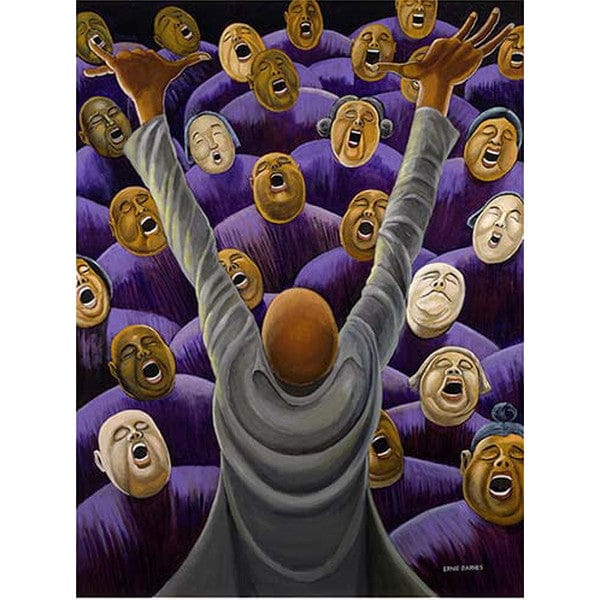
Art by Ernie Barnes
Get The Round Table in your Inbox
Every now and again we send out a collection of our writings, links to our webcasts, and reminders about events. Subscribe to stay in touch.
