

Listen to the article
Listen to the session
Listen to the article
A famine is a terrible thing dreaded by the people. It was not just a shortage but a drastic change of life lasting years for everyone. It is not a downturn, bear market or even a recession. Famine forced Abraham to move to Egypt and Isaac to Philistia. Naomi and her husband moved to Moab. A famine forced Jacob and his sons to go to Egypt in the first place. People went to find food wherever they could – they uprooted themselves and did whatever was necessary to survive. It was not simply a temporary shortage of food. A famine tilts the axis of your world.
But this is a special famine. It is the disappearance of the word of the Lord. Far worse than hunger, it means the presence of The Lord will be withdrawn and nowhere to be found. There will be no prophets. None to tell the truth. None calling people to fairness and justice. The nation will be overcome by lies and corruption. When truth disappears it does not leave a vacuum. It is soon inhabited by lies and by men who love to lie for the lie itself.
Ironically, it is possible to be in a famine for the word of the Lord and not know it. We can be so inundated by “God words” and partial truth that we do not realize we have not heard the actual word of the Lord in years. Talking about God can become like wallpaper. We live in a world that is so saturated with “God words” of our making that are not the same as the word of the Lord. The Christian retail industry is a $5 billion business enterprise. There are 7,500 new Christian book titles every year. With 350,000 churches, radio stations, programs and products we can hear more religious content in a year than an Old Testament person heard in a lifetime – and it can create a numbness to God. God becomes Muzak. We hear but we do not have to listen. He is everywhere and nowhere at the same time. We have turned his omnipresence into background sound.
It could be said in our culture that God chatters but he does not speak. If you are on X (Twitter) you are familiar with the format of 140 characters until recently being the most you can use to say anything. That has a tendency to reduce everything to a short phrase or formula. For instance, these are typical Twitter quotes from Christian authors: “Let what is, be.” “Plant hope, harvest joy; plant fear, harvest doubt.” “Love each other now like you’re the warm up band for eternity.” “Anger is a symptom of soul anemia.” “Prayer is the hand of faith on the door knob of your heart.” None of these are bad – they just create a taste for what is short and quickly evaporates.
I read an article by linguist Dan Mrejeru that makes sense. We assume that primitive people have primitive languages that are not complex but Dan says it may be just the opposite. “Once a group gets civilized...the structure of the language undergoes simplification, often massive simplification. The more civilized...the language, the simpler and more dumbed-down the structure of the language is. The reason is that in a modern society...people want to get concepts and whatnot across in the simplest and quickest manner.”
We don’t have time to genuinely communicate and our language deteriorates into simple words and phrases – but not sentences and paragraphs. Think about conversations you have with people. Think about how we like our ideas packaged, refined and reduced to make them easily consumable. Have you been reading about fake foods? Producers are adulterating their products with cheap substitutes that might not be perceptible but they are cheapened products. That is what happens when people take the Word of God and cheapen it. There is artificial taste but no nourishment.
The Word has become a commodity. There is not a famine of quantity of God words but a famine of quality and truth. It is not a two-edged sword that cuts to the heart but a ladle for comfort food. It is far too much work to hear the word of The Lord unless it is entertaining and quickly absorbed. Donald Miller writes that our brains like simplicity that will not use up energy trying to understand complexity. Our souls can become the same. We want things packaged for easy consumption.
We have become sophisticated about so many things – investments, brands, online shopping, education – but less sophisticated about our understanding of God. We want it more simplified and formulaic. We want inspiration – not saturation. We do want a word from The Lord but that is literally what we want – a single word.
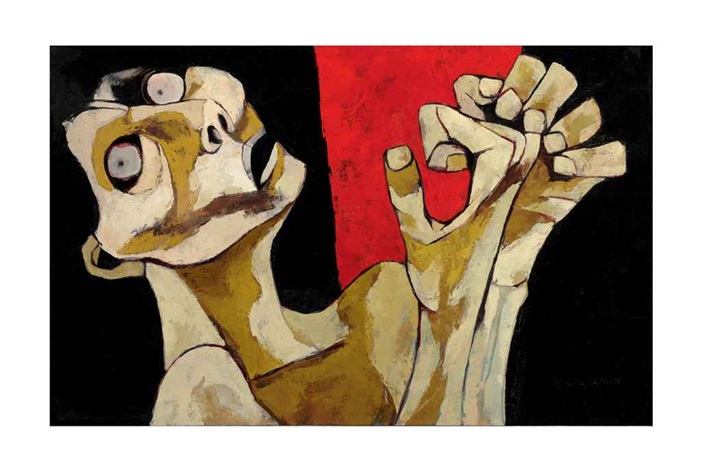
Art by Oswaldo Guayasamin
Get The Round Table in your Inbox
Every now and again we send out a collection of our writings, links to our webcasts, and reminders about events. Subscribe to stay in touch.
